The Ultimate Guide to Buy Sound Level Meter Calibrator in the UK
TL;DR / Quick Summary
When looking to buy a sound level meter calibrator in the UK, choosing between Class 1 (±0.25 dB) and Class 2 (±0.40 dB) depends on your legal and application requirements under BS 4142 and the Control of Noise at Work Regulations 2005. Essential features include BS EN IEC 60942:2018 compliance, dual 94 dB / 114 dB output levels, 1/2-inch cavity compatibility, and annual UKAS laboratory traceability.
Key Takeaways for Acoustic Professionals & Safety Inspectors
- Legal & Normative Mandate: In the UK, carrying out pre- and post-measurement calibration checks is a mandatory requirement under BS 4142:2014+A1:2019 and the Control of Noise at Work Regulations 2005 to ensure evidence is legally defensible.
- Class 1 vs Class 2 Standards: When you buy a sound level meter calibrator, Class 1 devices (conforming to BS EN IEC 60942:2018) provide a tight tolerance of ±0.25 dB for precision environmental and industrial audits, whereas Class 2 calibrators offer ±0.40 dB for general health and safety screening.
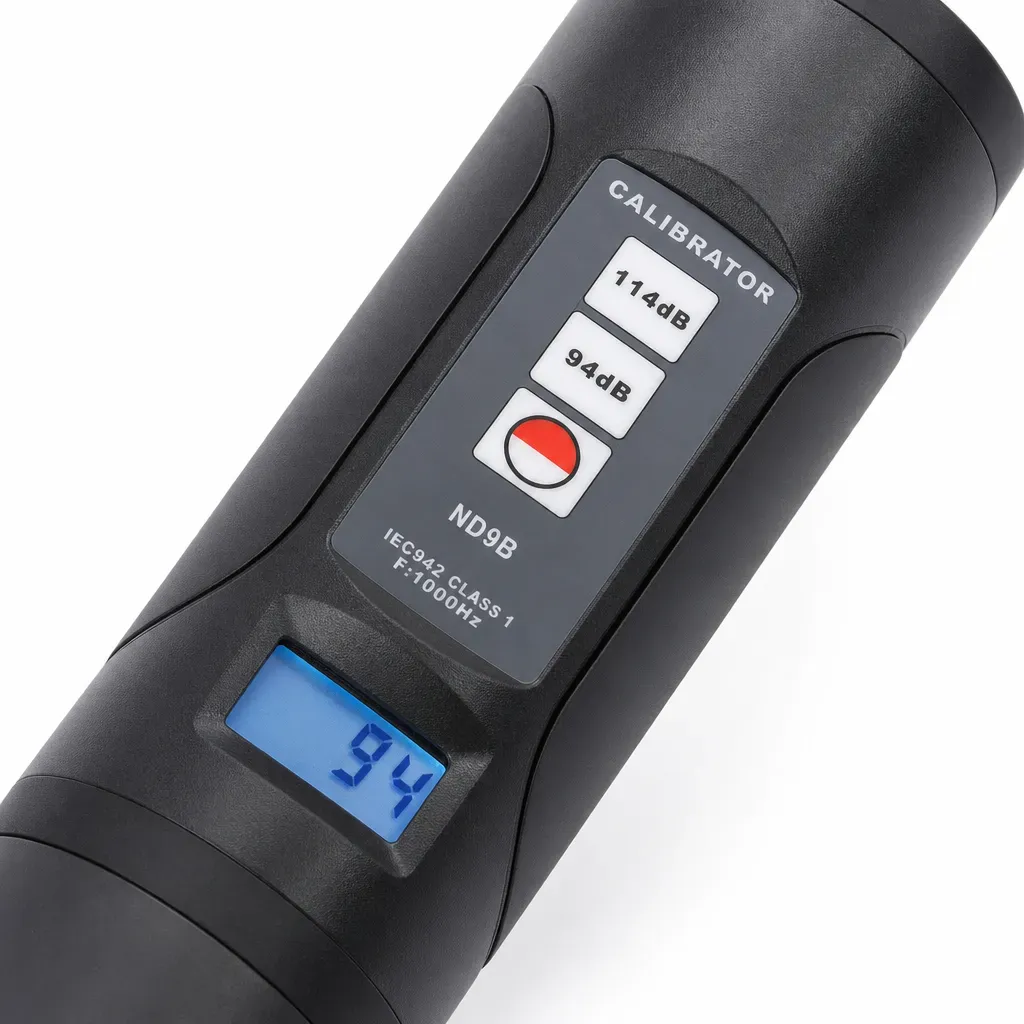
- Dual Reference Outputs (94 dB & 114 dB): A dual-output calibrator (94 dB SPL for baseline checks and 114 dB SPL for high-noise environments or testing in elevated background noise) is essential for field versatility across British industrial and construction sites.
- Microphone Cavity Adaptability: Ensure the calibrator features a standard 1/2-inch cavity with available precision adaptors for 1/4-inch microphones to maintain acoustic coupling without pressure leaks.
- UKAS Traceability: Annual laboratory recalibration by a UKAS-accredited facility remains vital to maintain the chain of measurement traceability, alongside daily field verification using your calibrator.
If you are looking to buy a sound level meter calibrator in the UK, the primary goal is securing absolute accuracy and regulatory compliance for your measurement data. Based on our testing at NoiseDecib, an acoustic calibrator is a precision handheld instrument designed to emit a stable reference tone—typically 94 dB or 114 dB at 1000 Hz—directly into a microphone diaphragm. This enables safety officers, Environmental Health Officers (EHOs), and acoustic engineers to verify measurement sensitivity in real time before and after taking field measurements.
Acoustic measurements form the bedrock of occupational safety, environmental planning assessments, building regulation compliance, and industrial hygiene throughout the United Kingdom. Whether you are an acoustic consultant undertaking a complex BS 4142 assessment for a prospective planning development, an Environmental Health Officer enforcing local authority noise abatement notices, or an occupational hygienist executing compliance surveys under the Control of Noise at Work Regulations 2005, your measurements are only as reliable as the reference standard used to verify them. Consequently, without rigorous, traceable field calibration performed immediately prior to and directly after a measurement dataset is captured, any sound level data collected is vulnerable to legal challenge, regulatory rejection, and commercial invalidation.
When engineering teams and safety specialists decide to buy sound level meter calibrator units, they are investing in the integrity of their data chain. An acoustic calibrator—often referred to as an acoustic calibrator, sound calibrator, or field calibrator—enables the operator to adjust or verify the sensitivity of the entire sound level meter measurement chain in real time, accounting for localized environmental variables such as atmospheric pressure fluctuations, humidity variations, and temperature shifts.
Furthermore, this buyer’s guide provides an authoritative, technical, and regulatory examination of acoustic calibrators within the British market. From examining the metrological nuances of BS EN IEC 60942:2018 compliance to evaluating dual-level reference outputs (94 dB and 114 dB), atmospheric compensation mechanisms, and UKAS traceability, our specialists deliver the technical intelligence required to make an informed investment for your organization.
Why is Field Calibration Legally Non-Negotiable in the UK?
In acoustic metrology, relying solely on an annual factory or laboratory calibration certificate is a dangerous operational oversight. Although an annual UKAS-accredited laboratory calibration verifies that an instrument met specification under controlled conditions at a specific point in time, it does not guarantee that the microphone capsule has suffered no physical drift, diaphragm damage, or sensitivity changes during transport, field deployment, or exposure to harsh weather across British job sites.
What standards govern sound level meter calibrators? (BS EN IEC 60942)
According to UK metrology standards, the international benchmark governing sound calibrators is BS EN IEC 60942 (Electroacoustics – Sound Calibrators). This standard dictates the performance metrics, acoustic tolerances, harmonic distortion limits, and environmental stability criteria that calibrators must satisfy to achieve certification. Specifically, the standard categorizes acoustic calibrators into distinct performance classes:
- Class 1 (LS and F): Designed for field use with Class 1 sound level meters (precision measurements), requiring high sound pressure level stability, minimal harmonic distortion (<1.5%), and strict sound pressure tolerances (±0.25 dB).
- Class 2 (F): Intended for general field assessment work with Class 2 meters, maintaining a maximum permissible tolerance of ±0.40 dB.
- Class C (Custom/Laboratory Standards): High-precision reference devices used primarily in primary metrology laboratories.
Therefore, when selecting hardware to buy a sound level meter calibrator, specifying a device that rigorously satisfies BS EN IEC 60942:2018 ensures your field reference aligns with national standards maintained by institutions like the National Physical Laboratory (NPL) in Teddington.
What are the HSE requirements under the Control of Noise at Work Regulations 2005?
Under the UK Health and Safety Executive (HSE) publication L108: Controlling Noise at Work – Guidance on Regulations, duty holders are mandated to conduct risk assessments using properly calibrated equipment. If a worker suffers noise-induced hearing loss (NIHL) and files a civil claim or if the HSE conducts an inspection under the Control of Noise at Work Regulations 2005, sound level logs lacking documented pre- and post-calibration checks are routinely dismissed as unreliable.
"Field calibration checks must be carried out before and after each measurement session using a sound calibrator compliant with BS EN 60942. If the post-measurement check shows a drift greater than the tolerance specified by the manufacturer, the measurement results must be deemed invalid."
— HSE Guidance L108 (Second Edition, Paragraph 142)
How does field calibration support BS 4142 environmental noise assessments?
For environmental consultants conducting rating assessments for commercial and industrial sound under BS 4142:2014+A1:2019, field calibration is an explicit procedural requirement. Section 5.4 of BS 4142 states that the operation of the measurement system must be checked in the field using an acoustic calibrator before and after each series of measurements. Based on our testing at NoiseDecib, if the calibration reading drift exceeds 0.5 dB between the pre-survey check and the post-survey verification, the entire measurement dataset must be deemed invalid and re-surveyed.
What Key Features Should You Look for When Buying a Sound Level Meter Calibrator?
When determining which unit to purchase, several critical technical features define field performance across British occupational and environmental settings:
- Dual Sound Pressure Outputs (94 dB & 114 dB): A dual-output calibrator allows engineers to perform sensitivity checks across different dynamic ranges. The 94 dB setting serves baseline environmental checks, while the 114 dB setting overcomes high background ambient noise on active industrial or construction sites.
- 1000 Hz Reference Frequency: Operating at 1000 Hz ensures that frequency weightings (such as A, C, or Z weightings) have zero gain attenuation (0 dB correction), making field calibration straightforward across all sound level meters.
- Cavity Size and Adaptor Options: Standard calibrator cavities are 1/2-inch (13.2 mm) to match standard measurement microphones. However, ensuring availability of 1/4-inch adaptors guarantees flexibility for smaller acoustic probes.
- Internal Barometric Pressure Compensation: High-performance Class 1 calibrators automatically compensate for ambient atmospheric pressure variations, maintaining reference accuracy regardless of altitude or changing atmospheric weather conditions.
How Often Does an Acoustic Calibrator Need UKAS Recalibration?
Although daily field checks verify your sound level meter, the calibrator itself requires routine laboratory verification. According to UKAS (United Kingdom Accreditation Service) guidance and BS EN IEC 60942 recommendations, sound calibrators must undergo formal laboratory calibration annually (or at a maximum of every 2 years) to preserve an unbroken chain of traceability to national metrological standards.
Frequently Asked Questions About Buying Sound Level Meter Calibrators
What is the main difference between Class 1 and Class 2 sound level meter calibrators?
Class 1 calibrators offer a tighter accuracy tolerance (±0.25 dB) and lower harmonic distortion, making them mandatory for precision environmental noise surveys under BS 4142. Class 2 calibrators offer a tolerance of ±0.40 dB, which is sufficient for general occupational hygiene and workplace noise assessments under the Control of Noise at Work Regulations 2005.
Can I use a Class 1 calibrator with a Class 2 sound level meter?
Yes. You can safely use a Class 1 calibrator with a Class 2 sound level meter, as the higher accuracy reference exceeds Class 2 requirements. However, you must never use a Class 2 calibrator to calibrate a Class 1 meter, as doing so invalidates the Class 1 measurement accuracy required for official surveys.
Why is 1000 Hz the standard reference frequency for acoustic calibrators?
At 1000 Hz, standard acoustic weighting networks (A-weighting, C-weighting, and Z-weighting) have an attenuation of exactly 0 dB. Consequently, the calibrator reading can be verified directly on the meter regardless of which frequency weighting mode is selected.
Ready to upgrade your field setup with NoiseDecib?
Explore Calibrator — £113.90