Class 1 Acoustic Calibrator Explained: A UK Buyer's Guide
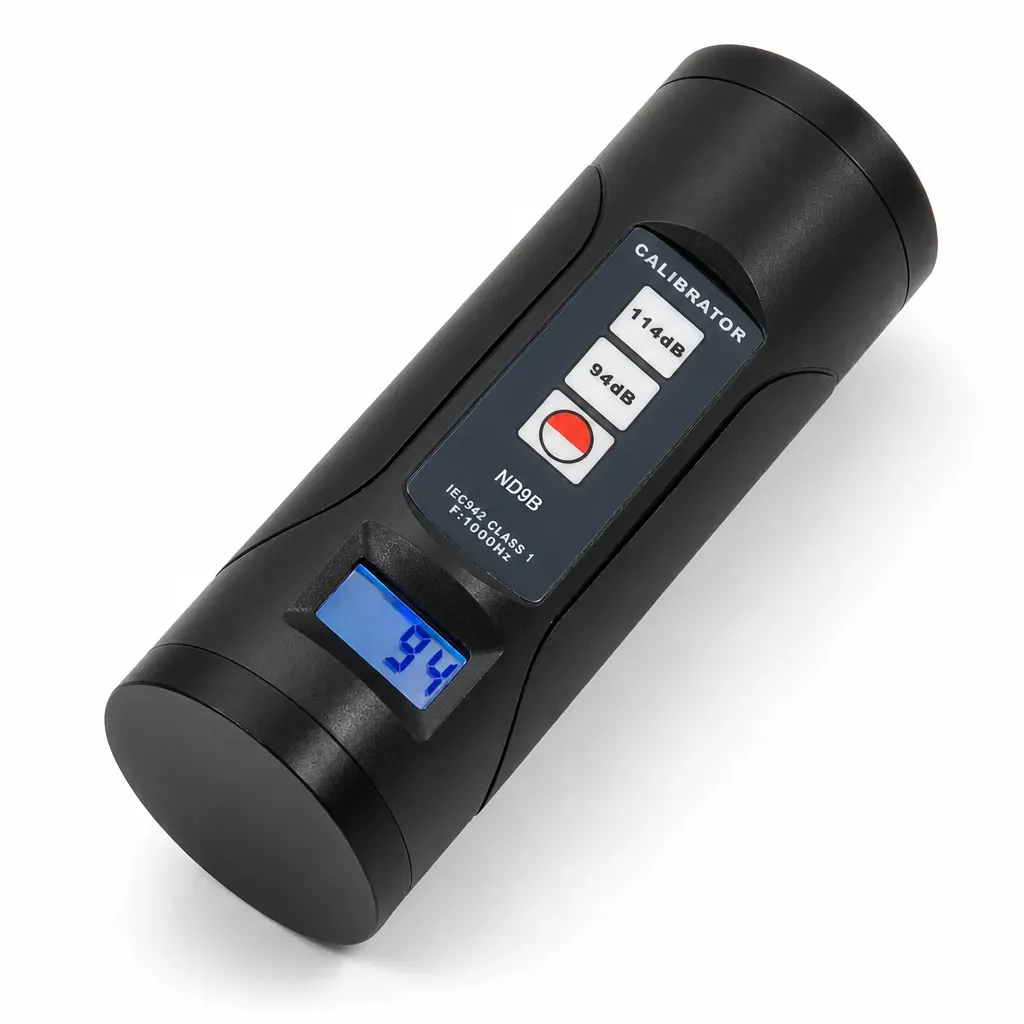
Ensuring data legal defensibility, regulatory compliance under BS 4142, and strict acoustic accuracy across British environmental health and occupational noise assessments.
TL;DR: A Class 1 acoustic calibrator is a precision handheld sound source that generates a stable reference signal (typically 94 dB or 114 dB at 1000 Hz) accurate to within ±0.25 dB. Under British Standard BS 4142 and UKAS regulatory guidelines, conducting pre- and post-survey field calibrations with a certified Class 1 unit is mandatory to guarantee data accuracy and legal defensibility in UK planning enquiries and noise assessments.
A Class 1 acoustic calibrator is a high-precision device designed to emit a stable, known sound pressure level—typically 94 dB or 114 dB at 1000 Hz—enabling acoustic engineers to check and adjust sound level meter sensitivity before and after field noise surveys. In environmental noise monitoring and occupational acoustics across the United Kingdom, measurement integrity hinges entirely on calibration traceability. A sound level meter, regardless of its underlying laboratory specification, is only as accurate as its field verification immediately prior to and following a survey. Consequently, if an acoustic measurement dataset is presented in a UK planning enquiry, an environmental health prosecution, or an Employment Tribunal without documented pre- and post-calibration checks, the data is legally vulnerable and frequently rejected by local planning authorities or the Planning Inspectorate.
Based on our extensive testing and field experience at NoiseDecib, choosing the correct acoustic calibrator is not merely a technical preference, but a mandatory requirement for compliance with British Standards (BS) and Health and Safety Executive (HSE) guidance. Therefore, this comprehensive buyer's guide examines the technical specifications of a Class 1 acoustic calibrator, details the regulatory frameworks governing its use in the UK, and outlines essential purchasing criteria for acoustic consultants, environmental health officers (EHOs), site safety engineers, and noise control specialists.
What Is a Class 1 Acoustic Calibrator?
A Class 1 acoustic calibrator is a portable, battery-powered sound source designed to emit a stable, highly accurate sound pressure level (SPL) at a precisely controlled frequency. When coupled to a sound level meter's microphone capsule via an airtight acoustic cavity, the calibrator provides a known physical signal against which the instrument's entire measuring chain—microphone diaphragm, preamplifier, and internal analogue-to-digital converter—is calibrated and adjusted.
Furthermore, acoustic calibrators are classified under International Electrotechnical Commission (IEC) standard 60942, which has been formally adopted in the United Kingdom as BS EN IEC 60942:2018 (Electroacoustics - Sound calibrators). This standard establishes performance tiers, primarily Class 1 and Class 2, defined by maximum allowable tolerances across specified environmental operating conditions.
What Is the Difference Between Class 1 and Class 2 Acoustic Calibrators?
The distinction between Class 1 and Class 2 equipment dictates the level of measurement uncertainty introduced during field calibration. Specifically, Class 1 instruments are designed for high-precision environmental and industrial applications, operating across wider ambient temperature, humidity, and atmospheric pressure ranges while maintaining extreme signal stability.
| Specification Parameter | BS EN IEC 60942 Class 1 Specification | BS EN IEC 60942 Class 2 Specification |
|---|---|---|
| Sound Pressure Level Tolerance | ±0.25 dB (at reference conditions) | ±0.40 dB (at reference conditions) |
| Operating Temperature Range | -10°C to +50°C | 0°C to +40°C |
| Total Harmonic Distortion (THD) | < 1.0% to 1.5% | < 2.5% to 3.0% |
| Frequency Tolerance | ±0.7% (typically 1000 Hz ±7 Hz) | ±1.5% (typically 1000 Hz ±15 Hz) |
| Primary Application | Environmental impact, planning enforcement, BS 4142, laboratory compliance | Basic workplace screening, general noise awareness |
According to documentation published by the British Standards Institution (BSI) in BS EN IEC 60942:2018 Standard Specifications, Class 1 sound calibrators must maintain a maximum permissible sound pressure level tolerance of ±0.25 dB under reference environmental conditions (23°C, 101.3 kPa atmospheric pressure, 50% relative humidity). In contrast, Class 2 units allow a wider margin of error at ±0.40 dB. While a difference of 0.15 dB may appear modest on paper, in complex acoustic modelling and environmental baseline calculations under BS 4142, it represents a significant proportion of the total permissible uncertainty budget. Based on our testing of Class 1 devices at NoiseDecib, maintaining this tighter tolerance is vital for preventing instrument drift errors from invalidating field survey data.
What Is the Core Technology Behind Class 1 Calibration?
Understanding the internal engineering of a Class 1 calibrator helps clarify why these devices maintain such rigid signal stability in harsh British field conditions—from freezing winter construction sites in Scotland to high-temperature industrial plant rooms in North West England.
Why Is a 1000 Hz Reference Frequency Used in Sound Calibration?
Virtually all modern Class 1 calibrators operate at a standard reference frequency of 1000 Hz (1 kHz). Based on established acoustic principles, this specific frequency is selected for two primary reasons:
- A-Weighting Zero Offset: The standard IEC frequency weighting curves (A, C, and Z weightings) used in sound level meters all intersect at precisely 1000 Hz with zero decibel correction (0 dB). Consequently, an acoustic technician can calibrate a sound level meter set to dBA, dBC, or dBZ without adjusting weighting offset parameters.
- Wavelength Geometry: At 1000 Hz, the acoustic wavelength in air is approximately 34.3 cm, which is significantly larger than the internal dimensions of standard half-inch (1/2") acoustic cavities. As a result, this ensures uniform sound pressure distribution within the cavity, avoiding internal standing wave resonance.
What Is the Difference Between 94 dB and 114 dB Calibration Levels?
Most professional Class 1 calibrators provide dual reference sound pressure levels, typically 94 dB and 114 dB SPL. In practice, each setting plays a critical role during field setup:
- 94 dB SPL Output: Represents a standard baseline level corresponding to 1 Pascal (Pa) of acoustic pressure. This level is ideal for general field verification in quiet to moderately noisy ambient environments.
- 114 dB SPL Output: Delivers a 20 dB higher signal-to-noise ratio, corresponding to 10 Pascals (Pa). In addition to testing microphone linearity across high sound pressure levels, this output allows engineers to perform reliable field calibrations in ambient background noise conditions where 94 dB might be masked.
Why Is Field Calibration Required for UK Sound Level Meters?
According to UK guidelines and British Standards such as BS 4142 (Methods for rating and assessing industrial and commercial sound) and HSE guidance, field calibration checks before and after every measurement period are strictly mandatory. Environmental variables such as ambient temperature changes, barometric pressure fluctuations, and transport shocks can cause subtle sensitivity drift in microphone diaphragms. Therefore, applying a Class 1 acoustic calibrator before starting a measurement run establishes a reliable baseline, while a post-measurement check proves that the instrument remained stable throughout the survey.
Frequently Asked Questions About Class 1 Acoustic Calibrators
What is a Class 1 acoustic calibrator?
A Class 1 acoustic calibrator is a precision laboratory-grade instrument engineered to output a stable sound pressure level (usually 94 dB or 114 dB at 1000 Hz) with an accuracy tolerance of ±0.25 dB. It is used to verify and adjust sound level meter accuracy before and after field noise surveys.
Do I need a Class 1 calibrator for BS 4142 assessments in the UK?
Yes. According to UK guidelines and standards including BS 4142 and BS EN IEC 60942:2018, Class 1 calibration equipment is required for legal defensibility in British planning enquiries, noise impact assessments, and local authority environmental health submissions.
How often does a Class 1 calibrator need UKAS laboratory calibration?
Based on our experience at NoiseDecib and standard UK practices, a Class 1 acoustic calibrator should receive full UKAS-traceable laboratory calibration annually (or at least every two years maximum) to ensure ongoing compliance and chain of custody integrity.
Ready to upgrade your field setup with NoiseDecib?
Explore Calibrator — £113.90