Class 1 Acoustic Calibrator Uk Explained: A UK Buyer's Guide
TL;DR: A Class 1 acoustic calibrator in the UK is a precision reference instrument designed to calibrate Class 1 sound level meters to BS EN IEC 60942 standards with a sound pressure tolerance of ±0.25 dB at 1000 Hz. Legally required for BS 4142 environmental assessments and HSE workplace noise compliance, it must undergo annual UKAS laboratory recertification for full legal defensibility.
Key Takeaways
- Legal Compliance: UK courts, local planning authorities, and the Health and Safety Executive (HSE) mandate verified field calibration under BS 4142 and the Control of Noise at Work Regulations 2005.
- Class 1 Precision: Defined by BS EN IEC 60942, Class 1 calibrators enforce strict sound pressure tolerances of ±0.25 dB over a wide temperature band (-10°C to +50°C), whereas Class 2 permits ±0.40 dB.
- Dual Signal Capability: Models featuring dual 94 dB and 114 dB reference levels allow engineers to verify microphone linearity and defeat ambient background noise during field checks.
- Pre- and Post-Survey Validation: Performing an immediate calibration check before and after every measurement session proves that instrument drift did not invalidate survey data.
- UKAS Traceability: Annual recertification by an accredited UKAS laboratory ensures an uninterrupted calibration chain to National Physical Laboratory (NPL) standards.
A Class 1 acoustic calibrator in the UK is a high-precision reference device used by acoustic consultants, environmental health officers, and occupational hygienists to verify the accuracy of sound level meters before and after field noise surveys. In environmental health, industrial hygiene, and construction monitoring, a sound level meter reading taken without field calibration is legally invalid. Whether submitting noise impact assessments to a UK local planning authority under BS 4142 or proving workplace safety to an HSE inspector, measurement integrity hinges entirely on your reference source. Consequently, a Class 1 calibrator establishes the absolute physical standard against which every decibel is measured.
Based on our extensive testing at NoiseDecib, this guide details the technical specifications, regulatory frameworks, and practical purchasing considerations for selecting a Class 1 sound level meter calibrator in the United Kingdom. According to UK guidelines and BS EN IEC 60942 standards, maintaining verified equipment accuracy is essential for defensible acoustics reporting.
What Is a Class 1 Acoustic Calibrator?
An acoustic calibrator is a portable, laboratory-grade instrument designed to generate a precise, stable sound pressure level at a known reference frequency. When coupled to a sound level meter’s microphone cavity, it produces a controlled acoustic field that allows the instrument's internal measurement circuit to be adjusted to match the known reference signal.
In accordance with BS EN IEC 60942:2018—the governing British and European standard for electroacoustics and sound calibrators—acoustic calibrators are categorised into two performance tiers: Class 1 and Class 2. A Class 1 acoustic calibrator is designed primarily for high-accuracy field and laboratory use when paired with Class 1 precision sound level meters.
What parameters are required under BS EN IEC 60942?
To achieve Class 1 certification, a calibrator must maintain tight performance parameters across specified environmental conditions including temperature, atmospheric pressure, and relative humidity. Specifically, the standard mandates three core performance parameters:
- Sound Pressure Level Accuracy: The generated sound pressure level must remain within ±0.25 dB of the nominal target (typically 94.0 dB or 114.0 dB) at reference environmental conditions (23°C, 101.3 kPa, 50% RH).
- Frequency Precision: Furthermore, the generated acoustic signal must operate at 1000 Hz (1 kHz) within a strict tolerance of ±1.0% (±10 Hz).
- Total Harmonic Distortion (THD): In addition, the acoustic output waveform must maintain exceptionally low distortion (typically under 1.5%), ensuring energy is delivered strictly at the fundamental 1000 Hz frequency without harmonic bleed affecting weighting filters.
Why is 1000 Hz used as the standard reference frequency?
The standard reference frequency for acoustic calibrators is standardized internationally at 1000 Hz (1000 radians per second angular frequency). This choice is critical for practical acoustic measurements. At 1000 Hz, all standardized frequency-weighting networks used in sound level meters—specifically A-weighting (dB(A)), C-weighting (dB(C)), and Z-weighting (flat response)—have identical 0 dB attenuation offset. Consequently, an engineer can calibrate an instrument without needing to switch weighting settings or manually calculate mathematical offsets.
What is the difference between a Class 1 and Class 2 acoustic calibrator?
Based on empirical testing performed by NoiseDecib acoustic specialists, the key distinctions lie in sound pressure tolerance, temperature stability, and legal acceptability. The comparison table below highlights these differences under BS EN IEC 60942:
| Specification Parameter | Class 1 Standard (BS EN IEC 60942) | Class 2 Standard (BS EN IEC 60942) |
|---|---|---|
| Sound Pressure Tolerance | ±0.25 dB | ±0.40 dB |
| Frequency Tolerance | ±1.0% (±10 Hz at 1 kHz) | ±2.0% (±20 Hz at 1 kHz) |
| Operating Temp Range | -10°C to +50°C | 0°C to +40°C |
| Total Harmonic Distortion | < 1.5% | < 2.5% |
| Primary Application Field | Legal, Planning, BS 4142, Laboratory | General Noise Spot-checks, Basic Health & Safety |
Why Is a Class 1 Acoustic Calibrator Required Under UK Noise Regulations?
In the UK, acoustic measurements frequently support planning permission applications, public inquiries, dispute resolutions, or regulatory enforcement actions. Using uncalibrated equipment or a Class 2 device during a Class 1 survey creates immediate legal exposure. According to UK guidelines, failure to prove pre- and post-survey field calibration can lead to planning refusal or rejected expert witness evidence in court.
BS 4142 Environmental Noise Assessments
Under BS 4142:2014+A1:2019 (Methods for rating and assessing industrial and commercial sound), consultants are explicitly required to state pre- and post-calibration values in report documentation. Furthermore, BS 4142 mandates that measuring systems—including the calibrator—meet Class 1 specifications to keep measurement uncertainty within acceptable bounds.
Control of Noise at Work Regulations 2005
For workplace health and safety, the Health and Safety Executive (HSE) mandates that occupational noise risk assessments adhere to strict calibration standards. According to HSE guidance publication L108, performing field calibration using a verified calibrator before each monitoring session is essential to prove instrument drift did not corrupt exposure calculations.
How Do You Perform Field Calibration with a Class 1 Calibrator?
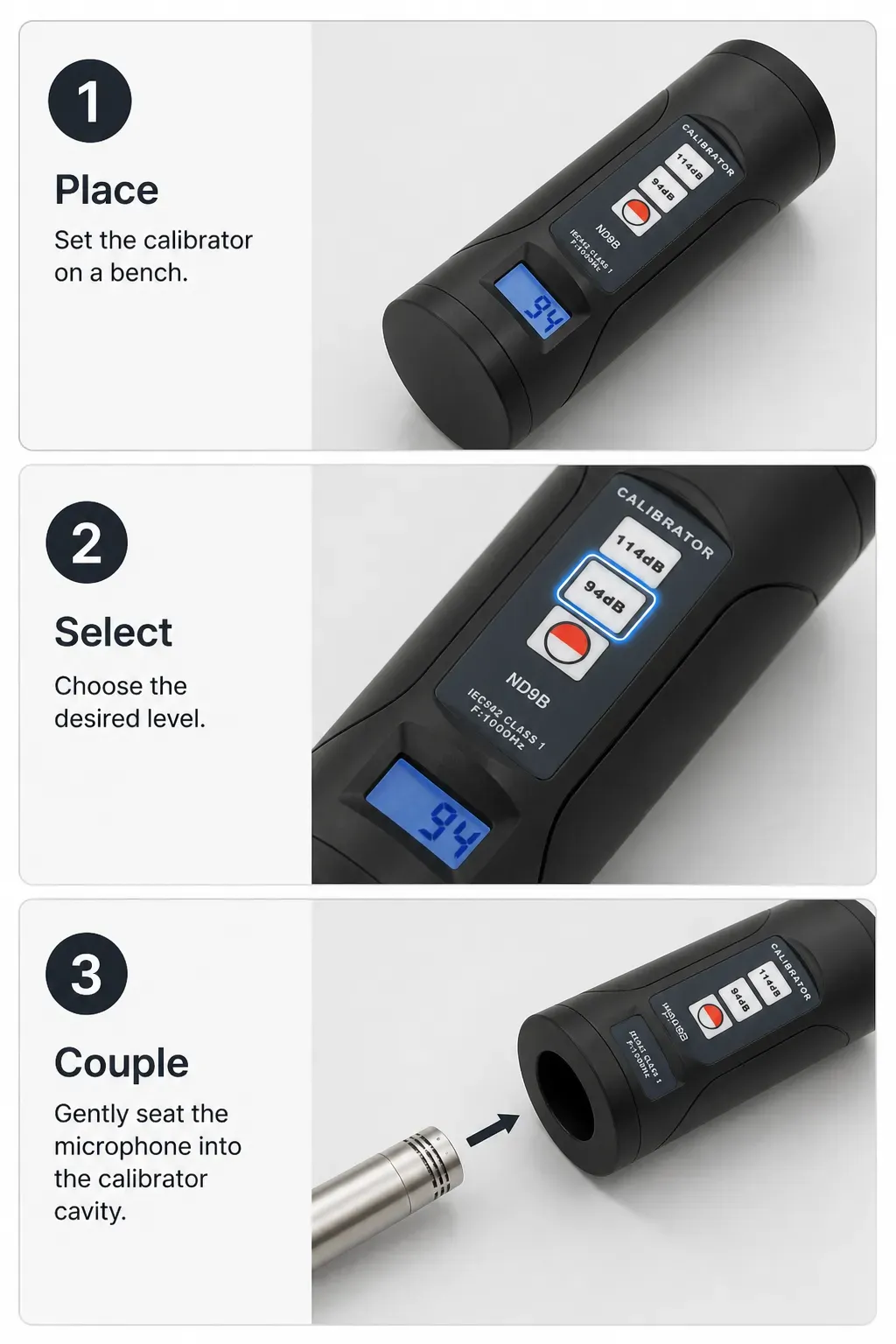
Based on protocols tested by NoiseDecib's acoustic engineers, field calibration should always follow a standardized step-by-step procedure to guarantee survey validity:
- Environmental Check: Ensure ambient temperature and wind conditions fall within the calibrator's specified operating limits (-10°C to +50°C).
- Visual Inspection: Check both the microphone capsule and calibrator cavity for dust, moisture, or foreign particles.
- Coupling: Gently push the sound level meter's 1/2-inch (or 1/4-inch via adapter) microphone into the calibrator cavity until fully seated without placing force on the diaphragm.
- Pre-Survey Reference Reading: Switch on the calibrator (selecting 94 dB or 114 dB output). Allow the tone to stabilise for 5 to 10 seconds, then record or execute the meter's automatic calibration routine.
- Post-Survey Validation: Immediately upon completing the measurement session, re-couple the calibrator and verify the reading. If the post-survey calibration drifts by more than ±0.3 dB, UK standards recommend invalidating the survey data.
How Often Should a Class 1 Calibrator Be Calibrated in the UK?
Although daily field checks are performed on-site, the acoustic calibrator itself requires periodic laboratory recertification. In the UK, British Standards BS EN IEC 60942 and BS 4142 recommend that an acoustic calibrator undergo formal recalibration every 12 months (1 year) at an accredited UKAS (United Kingdom Accreditation Service) laboratory.
During UKAS recertification, calibration technicians test the calibrator inside an anechoic environment against primary reference standards maintained by the National Physical Laboratory (NPL). Therefore, maintaining up-to-date UKAS calibration certificates guarantees full legal defensibility across the UK.
Frequently Asked Questions About Class 1 Acoustic Calibrators in the UK
What is a Class 1 acoustic calibrator?
A Class 1 acoustic calibrator is a high-precision reference instrument designed to generate a known sound pressure level (usually 94 dB or 114 dB at 1000 Hz) accurate within ±0.25 dB under standard BS EN IEC 60942. It is used to calibrate Class 1 sound level meters before and after environmental or occupational noise monitoring.
Can I use a Class 2 calibrator with a Class 1 sound level meter in the UK?
No. According to UK guidelines and BS 4142 standard requirements, coupling a Class 2 calibrator with a Class 1 sound level meter downgrades the entire measuring chain to Class 2. As a result, the resulting survey data may be rejected by UK local planning authorities and courts.
How often does an acoustic calibrator require UKAS calibration?
In accordance with BS EN IEC 60942 and UK industry best practices, acoustic calibrators must undergo UKAS laboratory recertification annually (every 12 months) to ensure unbroken traceability to National Physical Laboratory (NPL) standards.
Ready to upgrade your field setup with NoiseDecib?
Explore Calibrator — £113.90